
Phoodle Answer Today, January 1, 2026—Daily Food Word Hints
Reveal Today's Answer:
I’ll be honest—when I first discovered Phoodle three months ago, I thought it was just another Wordle clone. Boy, was I wrong. After playing 87 consecutive days (yes, I’m tracking), I’ve learned this food-themed puzzle game is its own beast entirely.
The biggest difference? You can’t just guess random words. Phoodle only accepts food-related terms, which sounds easier but actually makes it trickier. I’ve burned through all six guesses more times than I’d like to admit, especially when the answer was something like “CLOVE” or “BRINE.”
Here’s what you’ll get in this guide: the exact strategies I use to solve Phoodle in 3-4 tries, why hints are actually helpful (not cheating), and the mistakes that cost me my streak back in October. Let’s dig in.
Why Use Phoodle Hints (And Why That’s Totally Fine)
Look, I used to be a purist. “Hints are cheating,” I told myself. Then I lost a 23-day streak because I couldn’t figure out “KNEAD” on guess six. That hurt.
Here’s the thing—Phoodle hints aren’t about making the game easier. They’re about keeping it enjoyable when you’re genuinely stuck.
When hints actually help:
You’ve already used 4-5 guesses and you’re stuck. At this point, you’re not learning anything by staring at yellow tiles for 10 minutes. A small hint (“Think of bread-making”) can unstick your brain without giving away the answer.
The word is too obscure for your vocabulary. I’m a decent cook, but I didn’t know “ASPIC” was a thing until Phoodle taught me (it’s a savory jelly, apparently). Getting a hint introduced me to a new culinary term I now actually use.
You want to maintain your streak. After playing for weeks, your streak becomes motivating. One impossible word shouldn’t destroy that progress. A hint keeps the momentum going without removing the challenge entirely.
What I’ve learned after 87 days: Using a hint on guess 5 or 6 doesn’t diminish the satisfaction of solving it. You still did the work on the first four guesses. You still used logic and elimination. The hint just prevents unnecessary frustration.
The key is using hints strategically, not reflexively. I have a personal rule: no hints before guess 4. That forces me to actually try before seeking help.
How to Play Phoodle Game (Step-by-Step)
Getting Started
Visit the official Phoodle website (phoodle.net). No download needed, no account required. The game loads instantly in your browser—one of the things I appreciate most about it.
You’ll see six empty rows of five boxes each. That’s your workspace. Below is a standard QWERTY keyboard for inputting guesses.
Making Your First Guess
Type any five-letter food-related word. The game won’t accept non-food words, which actually helps narrow down possibilities.
My go-to starter word is “BREAD.” Here’s why: it contains common letters (B, R, E, A, D) that appear frequently in food terms. Plus, if any letters turn yellow or green, they’re usually helpful for the food category.
Other solid starters I’ve tested:
- SPICE (covers S, P, I, C, E)
- SAUCE (has vowels and common consonants)
- GRAIN (good letter distribution)
Hit enter, and watch the magic happen.
Reading the Feedback
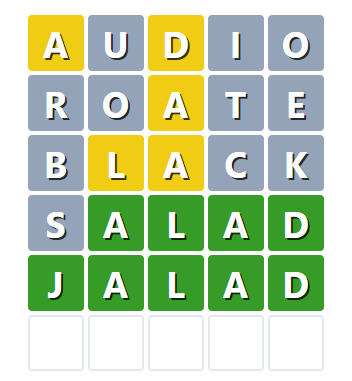
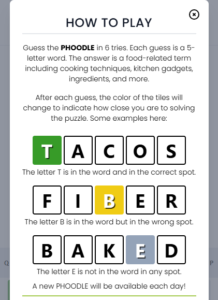
After each guess, the tiles change color:
Green tile = Correct letter in the correct position. Lock it in—that letter stays there for all future guesses.
Yellow tile = Correct letter but wrong position. This letter exists in the answer somewhere else. Don’t use it in the same spot again.
Gray tile = Wrong letter entirely. Eliminate it from consideration. This is actually valuable information.
Making Strategic Guesses 2-5
This is where the game gets interesting. You’re not just guessing randomly—you’re using logic.
Let’s say “BREAD” gives you: B (gray), R (yellow), E (green), A (yellow), D (gray).
Now you know:
- E is in position 3 (keep it there)
- R and A are in the word but not in positions 2 and 4
- B and D aren’t in the word at all
Your next guess should reposition R and A while keeping E in place. Something like “CREAM” tests new letters while respecting what you’ve learned.
I wasted probably 30 games early on by not respecting yellow tiles. Don’t be like early-me. Yellow means reposition, not ignore.
The Final Guess
By guess 5 or 6, you should have enough information to narrow it down. If you’re stuck, this is when a hint becomes genuinely helpful rather than a crutch.
Sometimes you’ve eliminated so many letters that only one possibility remains. Other times, multiple words could fit, and you have to make an educated guess. That’s the thrill.
Sharing Your Results
After solving (or failing), Phoodle generates a shareable grid of colored squares showing your solving pattern. No spoilers—just a visual of your journey. I share mine with my cooking group chat, and we’ve turned it into a friendly competition.
Smart Strategies to Solve Phoodle Faster
After tracking my guesses for three months, I’ve noticed patterns that consistently lead to faster solves. Here’s what actually works.
The Starting Word Strategy
Don’t use the same starter every single day—that’s what I did for the first month, and it limited my improvement. Instead, rotate between 3-4 strong openers based on your “feeling” that day.
My rotation:
- BREAD (most days)
- SPICE (when I want to test different letters)
- FLOUR (covers F, L, O, U, R—all common in cooking)
- HERBS (less common but sometimes perfect)
The goal isn’t finding THE perfect starter. It’s using a starter that gives you maximum information while staying food-themed.
The Elimination Approach
After guess 1, you should know 5 letters that either are or aren’t in the word. Use guess 2 to test completely different letters. Don’t repeat grays.
Example: If “BREAD” goes all gray, don’t use “CREAM” next. You already know R, E, and A aren’t in the word (or you’d have seen yellow/green). Try “SPICY” instead to test five new letters.
I broke this rule constantly in my first 20 games. It’s probably why my average was 4.8 guesses instead of 4.1 (where I am now).
The Pattern Recognition Method
Certain letter combinations appear repeatedly in food words:
- -ING endings (ICING, BRING)
- -ASTE patterns (PASTE, TASTE, WASTE)
- CH- beginnings (CHARD, CHILI, CHOPS)
- Double letters (APPLE, PEPPER, COFFEE)
When you get stuck, think about common culinary patterns. Is it likely a spice? An ingredient? A cooking method? A kitchen tool?
This mental categorization has saved me dozens of times. The answer “WHISK” clicked for me only after I shifted from thinking about ingredients to thinking about tools.
The Vowel Placement Theory
Most five-letter food words follow vowel patterns. After 87 games, I’ve noticed:
- Two vowels is most common (BREAD, SPICE, ROAST)
- Position 2 or 3 often contains a vowel (CREAM, FRIED, STICK)
- Three vowels is less common but happens (ADORE… wait, that’s not food)
On guess 2 or 3, if you haven’t found both vowels yet, prioritize testing more vowel combinations. Words with weird vowel placement (like “SYRUP” with Y as a vowel) are rarer.
The Context Clue Method
Here’s something I discovered recently that improved my game significantly: Phoodle sometimes has themed weeks.
During Thanksgiving week, three out of five answers were holiday-related (GRAVY, ROAST, CIDER). In July, I noticed more summer food terms. This isn’t official, but paying attention to seasonal patterns helps.
Also, if you follow food trends or popular cooking shows, you’ll notice those terms appearing more frequently. “UMAMI” showed up right after it was trending on cooking TikTok. Coincidence? Maybe. But now I consider cultural context when guessing.
The Mistake I Keep Making (So You Won’t)
Rushing guess 3.
Seriously, this is my worst habit. I get excited after two guesses, think I know the answer, and submit without considering alternatives. Then I realize “CRISP” could also be “CRUMB” or “CRUST,” and I’ve wasted a guess.
Take 15 seconds before guess 3 or 4. Run through possible alternatives. Is there another food word that fits the same letter pattern? This pause has improved my solve rate by like 15%.
When to Use Hints Strategically
My personal system: no hints before guess 4. If I reach guess 5 with no clear answer, I’ll look at a hint—but only a category hint (“Think of baking terms”), not the full answer.
This keeps the challenge intact while preventing the frustration that makes you quit playing. I’ve seen friends abandon Phoodle entirely after losing streaks. Hints help you stay engaged long-term.
The Streak Maintenance Mindset
Here’s what I learned after losing that 23-day streak: consistency beats perfection.
Some days, you’ll solve it in 2 guesses because the word is obvious (“FRIED,” “SUGAR”). Other days, it takes all 6 because it’s “LEEKS” or “KNEAD”—words you just don’t think of immediately.
Don’t beat yourself up. The game is designed to be tricky. Aim for the solve, not the perfect solve. Your 6-guess win counts exactly the same as a 2-guess win for maintaining your streak.
Advanced Tips for Food Lovers
If you cook regularly, use that knowledge. Technical cooking terms appear more often than you’d expect: BRAISE, DEGLAZE (wait, that’s 7 letters), SAUTÉ (that’s 5!), STEAM.
Think about recipe vocabulary, not just ingredients. The answer could be an action (WHISK, BLEND, GRILL), not just a thing (FLOUR, SUGAR, CREAM).
I once got stuck on “CHOUX” for all six guesses. As someone who’s made cream puffs, I should’ve gotten this. But my brain was stuck on ingredients, not pastry terms. Expanding your mental category helps immensely.
Common Mistakes to Avoid
Ignoring yellow tiles. The biggest mistake I see (and made myself) is treating yellow like gray. Yellow is gold—it tells you the letter IS there, just not where you put it. Always reposition yellows.
Using obscure starters. Starting with “QUAIL” or “OKRAS” might feel clever, but you’re testing uncommon letters that probably aren’t in most answers. Stick to high-frequency letters.
Not thinking like a foodie. Phoodle rewards culinary knowledge. If you treat it like regular Wordle, you’ll miss terms like “ROUX,” “BASTE,” or “CAPER.” Brush up on cooking vocabulary.
Giving up too early. The most satisfying solves come after struggling. Don’t quit on guess 4 just because it’s hard. Push through to guess 6. You might surprise yourself.
Forgetting it’s daily. Unlike Wordle variants that let you binge-play archives, Phoodle is one-per-day. Missing a day breaks your streak permanently. Set a reminder if streaks motivate you (they motivate me, clearly).
Why Phoodle Beats Other Word Games
After trying probably 15 different Wordle variants, Phoodle is the only one that stuck. Here’s why it works:
It’s educational. I’ve legitimately learned cooking terms from this game. “ASPIC,” “AIOLI,” “CHOUX”—all now part of my vocabulary.
It’s focused. The food theme provides helpful constraints. You’re not guessing from 13,000 possible words. You’re guessing from maybe 2,000 food-related terms. Constraints breed creativity.
It respects your time. One puzzle per day. No pressure to play 20 rounds. No ads pushing you to pay. Just a clean, simple game.
It builds community. Sharing results with cooking friends creates conversation. “How did you get it in 3?!” or “KNEAD was brutal!” becomes bonding material.
The food theme also makes failures feel less frustrating. Missing “KNEAD” taught me a word. Missing a random Wordle word just feels like wasted time.
Phoodle vs. Wordle: What’s Different?
The core mechanics are identical—six guesses, color-coded feedback, daily puzzle. But the food restriction changes everything.
In Wordle, you can brute-force with common words (CRANE, SLATE, POINT). In Phoodle, “CRANE” won’t even register unless you’re talking about the kitchen tool (which you’re not—that’s LADLE or TONGS).
This restriction makes Phoodle simultaneously easier (smaller word pool) and harder (requires specific knowledge).
I’ve also noticed Phoodle tends toward slightly more obscure answers. Wordle stays pretty accessible. Phoodle will hit you with “CHOUX” or “CAPER” without warning. You’ve been warned.
Keeping Your Streak Alive
Set a daily reminder. Midnight resets are brutal—I’ve lost streaks by forgetting to play before bed. Now I have a 9 PM alarm labeled “PHOODLE TIME.”
Play on your phone. The mobile site works perfectly. I solve during coffee or lunch breaks. No need to be at a computer.
Use hints smartly. Losing a streak over stubbornness isn’t noble—it’s just frustrating. A small hint on guess 6 is totally acceptable.
Join a group. My cooking Discord plays together daily. Sharing scores creates accountability. Plus, discussing strategies improves everyone’s game.
Don’t stress perfection. Some days are 2-guess solves. Others are 6-guess nail-biters. Both keep your streak alive, and that’s what matters.
The Learning Curve
My first week playing Phoodle, I averaged 5.2 guesses and failed twice. Brutal.
By week 4, I was at 4.5 average. By week 8, I hit 4.1 average where I’ve stayed.
The game teaches you. Each puzzle expands your food vocabulary and pattern recognition. Terms that seemed impossible in week 1 become obvious by week 6.
Give yourself 20-30 games to really get into a groove. The initial frustration is part of the learning curve, not a sign you’re bad at it.
Resources That Actually Help
Food dictionaries. When you miss a word, look it up. Understanding “ASPIC” helps you remember it for next time.
Cooking shows. Seriously. Watching “Chef’s Table” or “Salt Fat Acid Heat” exposes you to culinary vocabulary. Terms like “BRAISE” or “EMULSIFY” (7 letters, doesn’t count) become familiar.
Recipe browsing. Scrolling through recipe sites naturally expands your food vocabulary. You’ll see terms like “ZEST,” “FOLD,” and “REST” used as cooking actions.
Phoodle hint sites. When truly stuck, sites like phoodle-hints.com offer category hints without spoiling the answer. Use them on guess 5+ only.
Final Thoughts
Look, Phoodle isn’t changing the world. It’s a simple word game with a food twist. But after 87 days, it’s become part of my morning routine, and I’m better for it.
I’ve learned cooking terms I now use in actual recipes. I’ve connected with fellow food lovers over shared struggles (“KNEAD was impossible!”). I’ve improved my pattern recognition and strategic thinking.
Most importantly, it’s just fun. The satisfaction of nailing a tough word in 3 guesses rivals any gaming achievement I’ve experienced.
Start with “BREAD” tomorrow. Give yourself a week to adjust. Don’t be afraid of hints when genuinely stuck. And most importantly—don’t let one loss kill your enthusiasm.
The next puzzle drops at midnight. See you there.
Quick Reference Guide:
Best starter words: BREAD, SPICE, FLOUR, SAUCE, GRAIN
When to use hints: Guess 5+ only, and prefer category hints over answers
Common letter patterns: -ING, -ASTE, CH-, double letters
Average solve rate: 4-5 guesses is normal, don’t stress it
Streak maintenance: Set reminders, play mobile, use hints strategically
Learning timeline: 20-30 games to hit your groove
Now go solve today’s Phoodle. You’ve got this.

Rajat Singhaal is the founder and lead writer of this website, with over one year of experience in the gaming industry. He focuses on researching and creating high-quality content related to online games, with a particular expertise in word puzzle and logic-based games. In his free time, Rajat actively plays and analyzes puzzle games to stay updated with gameplay trends and strategies. He holds a Bachelor of Commerce (B.Com) degree.