

Connections Game #926 Dec 23: Hints & Answers Today
Welcome to today’s NYT Connections puzzle #926 for December 23, 2025…
Get daily NYT Connections game hints and answers to crack the toughest challenges effortlessly! Discover today’s Connections solution, smart tips, and winning strategies that make every Connections a breeze. The Answer for Today is what everyone’s searching for, and we’ve got you covered!
The complexity of Today’s words is making guessing tricky for puzzle enthusiasts everywhere. But here’s the twist—when you see our solution, you’ll think, “We were so close to cracking it!” That satisfying “aha!” moment is just seconds away.
So let’s dive straight into Today’s Connections answer and hints without wasting another moment. Your winning streak starts right here, right now!

What is Connections?
Connections is a daily word puzzle from the New York Times where you identify four groups of four words that share a common theme. You’re given 16 words total, and you need to sort them into four categories.
The catch? The categories range from obvious to maddeningly obscure. And you only get four mistakes before you lose.
Each category has a difficulty color:
- Yellow = Easiest (straightforward connections)
- Green = Moderate (requires some thinking)
- Blue = Harder (trickier relationships)
- Purple = Hardest (wordplay, obscure links, or multiple meanings)
The game drops at midnight daily. One puzzle, one chance. Mess it up, and you wait until tomorrow.
Click To Reveal Hints
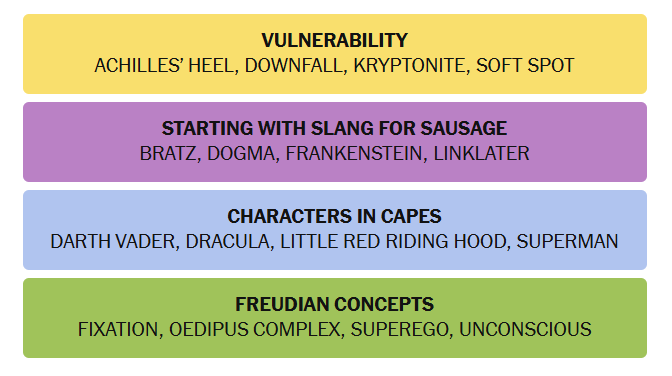
Here are today’s Connections categories.
YELLOW CATEGORY (Easiest)
VULNERABILITY
GREEN CATEGORY
FREUDIAN CONCEPTS
BLUE CATEGORY
CHARACTERS IN CAPES
PURPLE CATEGORY (Hardest)
STARTING WITH SLANG FOR SAUSAGE
IF YOU GOT THE ANSWER THEN GO BACK TO THE GAME
Here are today’s Connections words.
YELLOW CATEGORY
ACHILLES’ HEEL, DOWNFALL, KRYPTONITE, SOFT SPOT
GREEN CATEGORY
FIXATION, OEDIPUS COMPLEX, SUPEREGO, UNCONSCIOUS
BLUE CATEGORY
DARTH VADER, DRACULA, LITTLE RED RIDING HOOD, SUPERMAN
PURPLE CATEGORY
BRATZ, DOGAMA, FRANKENSTEIN, LINKLATERR
Today's Connections Answer

If you fail to find the answer, don’t worry. Try again tomorrow with a fresh mind.
“My solving journey today: Yellow was obvious—got it first try! Green took 2 attempts… Blue had me stuck for 5 minutes! Purple: Finally clicked when I realized [SLANG FOR SAUSAGE] Time: 8 minutes Mistakes: 1 What was YOUR score?”
Connections
Puzzle #926
🟨🟨🟨🟨
🟦🟦🟦🟪
🟪🟪🟪🟪
🟦🟦🟦🟦
🟩🟩🟩🟩
Connections Game: Complete Guide with Winning Strategies (2025)
I spent two weeks getting destroyed by Connections before finally cracking the code. My first 10 games? Failed 7 of them. Now, after 120+ puzzles, I solve most in 2-3 mistake-free attempts. The difference isn’t luck—it’s pattern recognition.
Connections is deceptively tricky. It looks simple: find four groups of four related words. But the New York Times designed it to mess with your brain through clever misdirection and overlapping categories. Here’s everything I learned the hard way so you don’t have to.
How to Play Connections Game
Getting Started
Visit nytimes.com/games/connections. No download needed, though you’ll want an NYT account to track your stats.
You’ll see 16 words arranged in a 4×4 grid. They look random, but trust me—they’re carefully chosen to confuse you.
Making Your First Guess
Select four words you think belong together. Tap or click each word to highlight it. Once you’ve selected four, hit “Submit.”
If you’re right, those four words disappear and reveal their category name. The remaining 12 words shuffle, and you continue.
If you’re wrong, you lose one of your four allowed mistakes. The words stay on the board, mocking you.
Reading the Feedback
After a wrong guess, the game tells you how many of your four words were actually in the same category:
- 0 correct = completely wrong group
- 1 correct = three words don’t belong together
- 2 correct = you’re mixing two different categories
- 3 correct = SO CLOSE but one word is wrong (the most frustrating)
This feedback is crucial. Getting “3 correct” means you’re on the right track—just swap out one word and try again.
The Shuffle Button
Stuck? Hit “Shuffle” to rearrange the words. Sometimes seeing them in different positions sparks recognition.
I shuffle probably 5-6 times per game. It genuinely helps break mental blocks when you’ve been staring at the same arrangement too long.
Winning or Losing
Find all four categories without making four mistakes? You win. The game shows your solving order and mistake count for sharing.
Make four mistakes before solving? You lose. The game reveals the answers, and honestly, you’ll feel dumb when you see what you missed.
Why Use Connections Hints (No Shame Here)
Look, Connections is hard. The purple category especially can be absurdly difficult—think “words that can follow ELECTRIC” or “_____ BEAR” word combinations.
I use hints maybe once every 15 games, usually when I’m on my third mistake and completely stumped. Using a hint is better than losing and learning nothing.
When hints actually help:
You’re stuck on the purple category with one mistake left. Purple categories often involve wordplay or obscure cultural references you might not know. A category hint (“think of compound words”) saves your game.
You’ve identified three categories but the last four words seem unrelated. Sometimes the final group is so weird that even after eliminating everything else, you still can’t see the connection. A hint prevents frustration.
You want to maintain your streak. After building a 40-day streak, losing to “types of fabric” (which you’d never have guessed included SATIN, SILK, CHIFFON, VELVET) feels terrible.
My hint rule: No hints until I’ve used 2 mistakes and still have no clear path forward. That forces genuine effort first.
The goal is learning patterns so you need hints less over time. After 120 games, I recognize common category types instantly.
Smart Approaches to Solving Connections
After 120+ games and way too much trial and error, here’s my proven system.
Start with the Obvious (Yellow Category)
Always hunt for the easiest category first. Yellow is usually straightforward: “types of fish,” “synonyms for happy,” “things in a kitchen.”
Scan all 16 words quickly. What four jump out as clearly related? If you see BASS, TROUT, SALMON, and COD, that’s your yellow category. Submit immediately.
Starting with yellow builds confidence and removes 4 words, making the remaining categories easier to spot.
I wasted my first 20 games trying to be clever and spot purple first. Bad strategy. Get the gimmes out of the way.
Look for Part-of-Speech Patterns
Categories often share grammatical structure:
- All verbs (JUMP, SKIP, BOUNCE, LEAP)
- All adjectives (BRIGHT, DARK, DIM, LIGHT)
- All nouns (CHAIR, TABLE, DESK, COUCH)
This narrows possibilities fast. If four words are clearly verbs while others aren’t, you’ve likely found a group.
Watch for Tricky Overlaps
Here’s where Connections gets evil—words that seem to fit multiple categories.
Example: The words POUND, BUCK, CHARGE, and DASH.
Your brain sees: “POUND and BUCK are money terms! And CHARGE means cost!”
But the actual category? “Things that can describe running quickly” (pound the pavement, buck forward, charge ahead, dash away).
This overlap is intentional. The game baits you into wrong guesses. Always consider multiple meanings before submitting.
Identify the Purple Category Tricks
Purple categories use common patterns:
- Words that precede/follow a word: “_____ BALL” (BASE, BASKET, FOOT, EYE)
- Homophones: Words that sound like numbers (WON/ONE, TO/TWO, etc.)
- Pop culture references: Disney movies, band names, TV shows
- Compound words: Two words that combine (FIRE + FLY = FIREFLY)
- Anagrams or wordplay: Rearranged letters or hidden words
After playing 120 games, I now automatically check for these patterns when I’m down to the last group.
The Elimination Strategy
Can’t see all categories? Find three definite groups, submit them, and the last four words are automatically your final category—even if you can’t figure out why they connect.
I’ve won probably 20 games this way. Sometimes the purple category is so obscure (“things that are also pasta shapes” or “words in famous quotes”) that elimination is smarter than guessing.
The “One Away” Technique
Got “3 correct” feedback? Systematically swap out each word and retest.
If your group was APPLE, BANANA, ORANGE, GRAPE and you got “3 correct,” one of those four is wrong. Try replacing GRAPE with every other available word until you find the right fruit.
This methodical approach beats random guessing and conserves your remaining mistakes.
Common Category Types to Know
After 120 games, here are the most frequent category types:
Easy (Yellow/Green):
- Synonyms (BIG, LARGE, HUGE, GIANT)
- Types of [thing] (ANIMALS, COLORS, COUNTRIES)
- Things found in [place] (BEACH, KITCHEN, OFFICE)
- Parts of [object] (CAR PARTS, BODY PARTS)
Medium (Blue):
- Words with shared prefix/suffix (-LESS, -ABLE, UN-)
- Slang terms for [concept] (MONEY, ATTRACTIVE, COOL)
- Brand names (TECH COMPANIES, CAR BRANDS)
- Historical figures (PRESIDENTS, SCIENTISTS)
Hard (Purple):
- Words that follow [word] (RED, BULL, TAPE, FLAG → all follow RED)
- Homophones or sound-alikes
- Hidden words (CARPET contains PET, CAR, etc.)
- Pop culture (BEATLES SONGS, MARVEL MOVIES)
- Anagrams or letter patterns
Recognizing these patterns speeds up solving dramatically.
Common Mistakes That Cost You Games
Submitting gut feelings without verification. I did this constantly early on. Four words “felt” related, so I submitted without checking if a different arrangement made more sense. Lost countless games this way.
Ignoring words with multiple meanings. The word SPRING could mean: the season, a metal coil, to jump, or a water source. Always consider alternate definitions.
Rushing after finding three categories. The last group is often the hardest. Don’t auto-submit the remaining four words without confirming they actually connect.
Not using the shuffle button. Seriously, shuffle! Seeing words in different positions helps your brain make new connections.
Forgetting about wordplay. If the straightforward categories aren’t working, the answer is probably wordplay or compound words. Shift your thinking.
Playing when tired. I’ve lost 4 streaks by playing Connections at midnight when exhausted. Your brain needs to be sharp for pattern recognition.
Why Connections is Harder Than Wordle
Wordle is linear—guess, adjust, repeat. Connections requires simultaneous pattern recognition across 16 words while dealing with intentional misdirection.
Wordle has one correct answer. Connections has four interconnected answers, and solving one wrong throws off the others.
Plus, Connections punishes guessing. In Wordle, you can brute-force test words. In Connections, four wrong guesses and you’re done. The stakes are higher.
That said, Connections is more satisfying when you solve it. That “aha!” moment when the purple category finally clicks? Unmatched.
Tracking Your Progress
Connections shows your stats: games played, win rate, current streak, and perfect game count (solving without mistakes).
My stats after 120 games:
- Win rate: 89%
- Current streak: 28 days
- Perfect games: 31
- Average mistakes: 1.4
Set improvement goals. Mine was reducing average mistakes from 2.5 to under 1.5. Tracking progress keeps the game engaging long-term.
Final Thoughts
Connections isn’t about vocabulary—it’s about pattern recognition and thinking flexibly. The best players don’t know more words; they consider more angles.
Start with the easiest category first. Watch for overlapping words with multiple meanings. Learn common purple category tricks. Use the shuffle button liberally. And don’t rush your final guesses.
Give yourself 30-40 games to develop your pattern recognition. Your first two weeks will be rough—I know mine were. By game 50, you’ll start seeing categories instantly. By game 100, you’ll understand how the puzzle makers think.
Don’t stress perfect games. Some puzzles have genuinely hard purple categories that even experts struggle with. A win with 3 mistakes beats a loss.
The next puzzle drops at midnight. Take your time, consider all angles, and remember—when stuck, shuffle and rethink.
Now go make those connections.
Quick Connections Strategy Recap:
Starting approach: Find the easiest (yellow) category first, eliminate obvious groups
Core strategy: Watch for word overlaps, consider multiple meanings, use elimination
Common patterns: Synonyms, types of things, prefix/suffix groups, compound words, pop culture
Purple tricks: Words that follow [word], homophones, anagrams, hidden words, wordplay
Average solve: 1-2 mistakes is solid, 0 mistakes is excellent, 3 mistakes is cutting it close
Hint usage: Only after 2 mistakes when genuinely stuck, category hints preferred
Win rate goal: 85%+ is good, 90%+ is excellent, 95%+ is expert level
Pro tip: Shuffle frequently—new arrangements reveal hidden patterns
BACK WITH NEW GAME


Rajat Singhaal is the founder and lead writer of this website, with over one year of experience in the gaming industry. He focuses on researching and creating high-quality content related to online games, with a particular expertise in word puzzle and logic-based games. In his free time, Rajat actively plays and analyzes puzzle games to stay updated with gameplay trends and strategies. He holds a Bachelor of Commerce (B.Com) degree.