
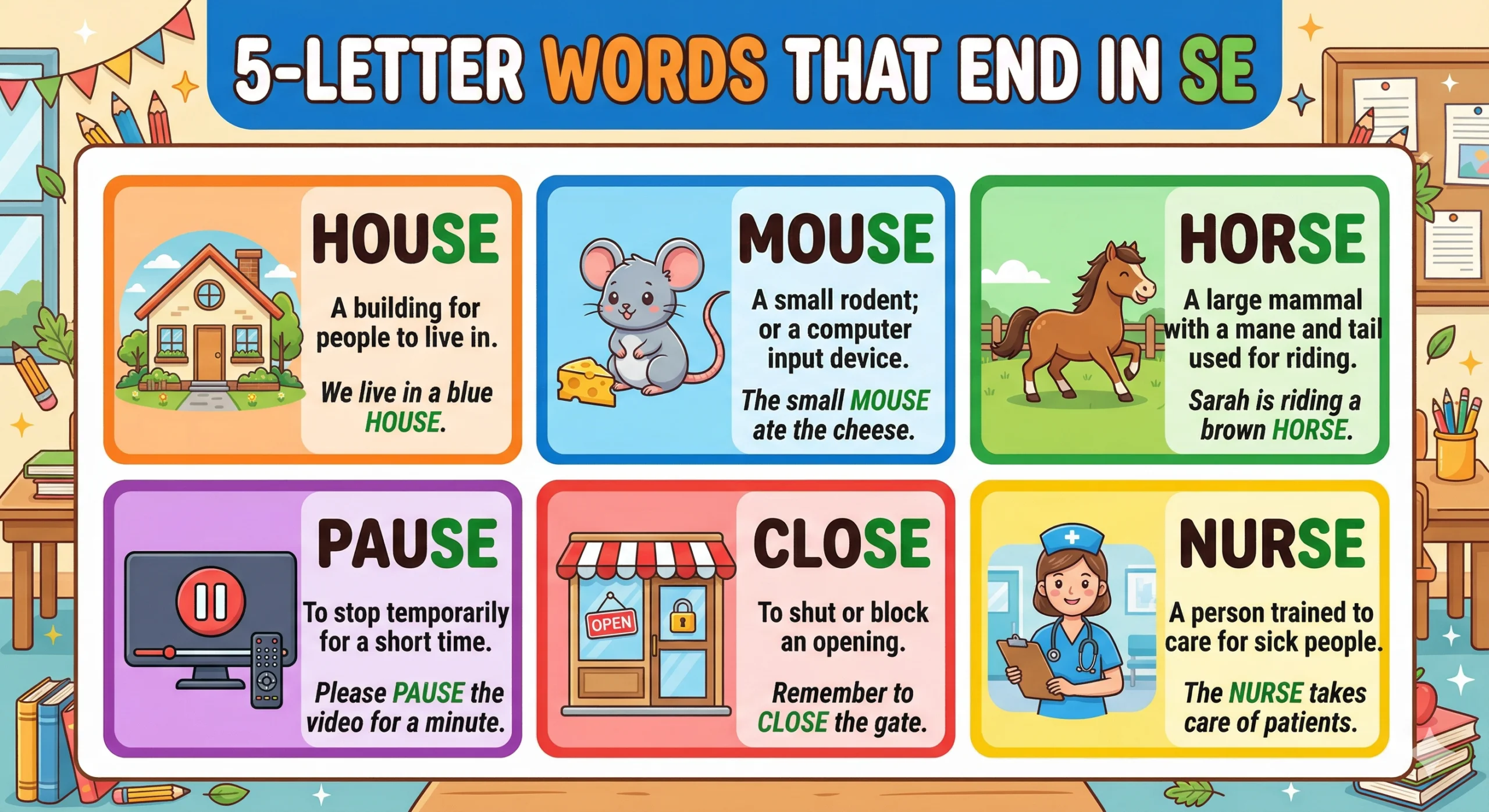
5-Letter Words That End in SE: The Complete Strategy List
Most lists of 5-letter words ending in “SE” are just automated dictionary dumps. They hand you a wall of text without distinguishing which words actually appear as Wordle solutions, which are obscure Scrabble-only terms, or how to strategically guess them without wasting turns.
If you play word puzzle games—or build them—understanding the “SE” suffix is critical. Because the letters “S” and “E” are high-frequency characters, their placement at the end of a word often creates what puzzle experts call a “Green Trap.” You lock in the “_ _ _ S E” ending early, only to realize that there are over 60 viable English words that fit in the remaining three slots.
This guide breaks down the complete list of 5-letter words ending in SE, categorizes them by their phonetic clusters, and provides the exact elimination strategies you need to solve puzzles efficiently.
What Makes the “SE” Ending a Strategic Trap?
In English orthography, the “SE” ending serves multiple linguistic functions. It acts as a suffix for adjectives (FALSE), a marker for verbs (CHASE), and a standard ending for hundreds of nouns (HOUSE).
For word game players, this creates a specific mathematical problem. The letter “E” is the most common letter in the English language, appearing in roughly 11% of all words. “S” is the third most common. When a puzzle algorithm selects a word ending in SE, players often identify these two letters on their first or second guess.
The trap activates when players try to guess the remaining three letters in order. If you guess MOUSE, then HOUSE, then ROUSE, you use up three attempts while adding very few new consonants to the board. To beat the algorithm, you must stop guessing the “SE” ending and start targeting the clusters that precede it.
The New York Times Wordle editor explicitly removed regular plural nouns ending in “S” or “ES” from the solution list (e.g., CARDS or BOATS will never be the answer). However, base words that naturally end in “SE” (like GOOSE, CHASE, or SENSE) remain highly active in the solution pool. Understanding this distinction prevents you from guessing invalid plural traps.
The Plural Rule Exception
The High-Probability Target List (Grouped by Cluster)
To solve these words efficiently, you must memorize the consonant and vowel clusters that most frequently precede the “SE” ending. Here are the core groups, filtered for common English usage.
1. The “-OUSE” and “-OOSE” Clusters
This trap is the most dangerous in 5-letter word games because the “O” and “U” are extremely common vowels. If you secure an “O _ _ S E” or board, test these words:
- HOUSE (Noun/Verb: A dwelling)
- MOUSE (Noun: A small rodent)
- LOUSE (Noun: Singular of lice)
- ROUSE (Verb: To awaken)
- SOUSE (Verb: To plunge in liquid)
- DOUSE (Verb: To drench)
- GOOSE (Noun: A large waterbird)
- MOOSE (Noun: A large deer)
- NOOSE (Noun: A loop with a running knot)
- LOOSE (Adjective: Not tightly fixed)
2. The “A-Vowel” Clusters (-AISE, -ASE, -AUSE)
When the letter “A” appears early in the word, it usually pairs with an I, a U, or a strong consonant before the SE.
- CHASE (Verb: To pursue)
- PHASE (Noun: A distinct period)
- ERASE (Verb: To remove)
- LEASE (Noun/Verb: A rental agreement)
- TEASE (Verb: To playfully provoke)
- CEASE (Verb: To stop)
- RAISE (Verb: To lift up)
- PRAISE (Noun/Verb: Expression of approval)
- CAUSE (Noun: A reason or motive)
- PAUSE (Noun/Verb: A temporary stop)
- ABASE (Verb: To behave in a belittling way.)
3. The Consonant Bridge Words
These words feature a strong consonant immediately preceding the “SE.” The most common bridge letters are R, L, and N. If you know the word ends in SE, testing an R or L is your highest-percentage move.
The “R” Bridge:
- CURSE (Noun/Verb: An offensive word or hex)
- NURSE (Noun: A medical professional)
- PURSE (Noun: A small bag for money)
- HORSE (Noun: An equine animal)
- WORSE (Adjective: Of poorer quality)
- TERSE (Adjective: Sparing in the use of words)
- VERSE (Noun: Writing arranged with a metrical rhythm)
- PARSE (Verb: To analyze a string or sentence)
The “L” and “N” Bridges: - FALSE (Adjective: Not true)
- PULSE (Noun: A rhythmic throbbing)
- SENSE (Noun: A faculty by which the body perceives.)
- TENSE (Adjective: Stretched tight)
- DENSE (Adjective: Closely compacted)
- RINSE (Verb: To wash lightly)
- LENSE (Noun: Variant spelling of “lens,” accepted in some dictionaries)
4. The “I” and “O” Modifiers
These words use an I or O to change the phonetic sound of the preceding consonant.
- ARISE (Verb: To stand up or emerge)
- NOISE (Noun: A sound)
- POISE (Noun: Graceful elegance)
- CLOSE (Verb/Adjective: To shut, or near to)
- THOSE (Pronoun: Plural of that)
- WHOSE (Pronoun: Belonging to associated person)
- CHOSE (Verb: Past tense of choose)
- OBESE (Adjective: Grossly fat or overweight)
Strategic Game Theory: How to Escape the SE Trap

If you are playing a digital puzzle and land on a board showing “_ _ _ S E” on your second guess, your instinct will be to guess a word like “HOUSE.”
Do not do this.
If the answer is “FALSE” or “guessing,” it only eliminates the H, O, and U. You still won’t know if the answer is FALSE, TENSE, RINSE, or PURSE. Instead, you must play a burner word.
Step 1: Execute a “burner” guess.
A burner word intentionally abandons the “SE” ending to test as many high-probability preceding letters as possible.
If you have “L,” your next guess should be a word that tests L, N, O, and U.
- Excellent Burner: “FLOUR” (Tests F, L, O, U, R)
- Excellent Burner: “BLANC” (Tests B, L, A, N, C)
- Excellent Burner: “CRONK” (Tests C, R, O, N, K)
By playing the game, if the ‘L’ highlights yellow, you immediately know that the word is likely FALSE or PULSE. If the ‘R’ highlights yellow, you pivot to the R-bridge words like PURSE, NURSE, or HORSE.
Step 2: Identify the Double Vowel
If your burner word confirms an ‘O’ and a ‘U,’ you are locked into the “-OUSE” cluster. From here, you only need to identify the leading consonant. A guess of “MACRO” will test the M (Mouse), C (Cause), and R (Rouse) at the same time.
The Complete Dictionary List (For Developers and Scrabble)
If you are developing a word puzzle game or playing competitive Scrabble (using the NASPA Word List or Collins Scrabble Words), you need the comprehensive list, including obscure words and non-standard plurals.
5-Letter Words Valid but Obscure (Good for Scrabble, Bad for Wordle)
These words are legally playable in competitive board games but are generally filtered out of modern digital puzzle solution lists because they are too obscure for the average vocabulary.
- BASSE (A classical dance)
- BOUSE (To haul with a tackle)
- COPSE (A small thicket of trees)
- CRUSE (A small container for liquids)
- DOWSE (To search for underground water)
- FOSSE (A ditch or moat)
- GOSSE (Australian slang for a good thing)
- HAUSE (A narrow neck or ridge)
- MANSE (A house occupied by a minister)
- PEASE (Archaic plural of pea)
- TAWSE (A leather strap used for punishment)
- VROSE (Obscure variant spelling)
A note for game developers: When building a puzzle database, separate your “Valid Guesses” array from your “Daily Solutions” array. Words like “TAWSE” should be accepted as a guess (so players don’t lose a turn for a valid dictionary word) but should never be selected as the puzzle of the day to prevent user frustration.
The Bottom Line
The “SE” ending represents a distinct structural pattern in the English language. It groups heavily around double vowels (O/U, A/I) and specific hard consonants (R, L, N).
Your next move: Instead of memorizing this entire list alphabetically, memorize the three core bridges: the -OUSE cluster, the R-Bridge (Purse, Nurse), and the L/N-Bridge (False, Tense). When you encounter an SE puzzle in the wild, stop trying to guess the whole word. Use a strategic burner word like “FLOUR” or “to” test the consonants, identify the bridge, and secure the win. The rest follows naturally from the data.

Aman Singhaal is the lead writer of this website, with over one year of experience in the gaming industry. He focuses on researching and creating high-quality content related to online games, with particular expertise in word puzzles and logic-based games. In his free time, Rajat actively plays and analyses puzzle games to stay updated with gameplay trends and strategies. He holds a Bachelor of Commerce (B.Com) degree.


