Waffle Solving Techniques: Beginner to Advanced
My first Waffle puzzle? Complete disaster. Used all 15 swaps and still couldn’t solve it. I stared at that failure screen wondering if I was missing something obvious.
Turns out I was missing a lot.
Over the next four months, I played 130+ puzzles and went from consistently using 14-15 swaps to averaging 9 swaps per solve. The shift wasn’t about getting smarter—it was about learning actual techniques instead of randomly moving letters around hoping for the best.
Here’s everything that took me from confused beginner to someone who rarely needs more than 10 swaps.
Beginner Techniques: Building Your Foundation
When you’re new to Waffle, start here. These techniques will immediately improve your solving without overwhelming you.
Technique 1: The Green Letter Anchor Method
This is where everyone should start. Green letters are already correct—they’re your fixed points.
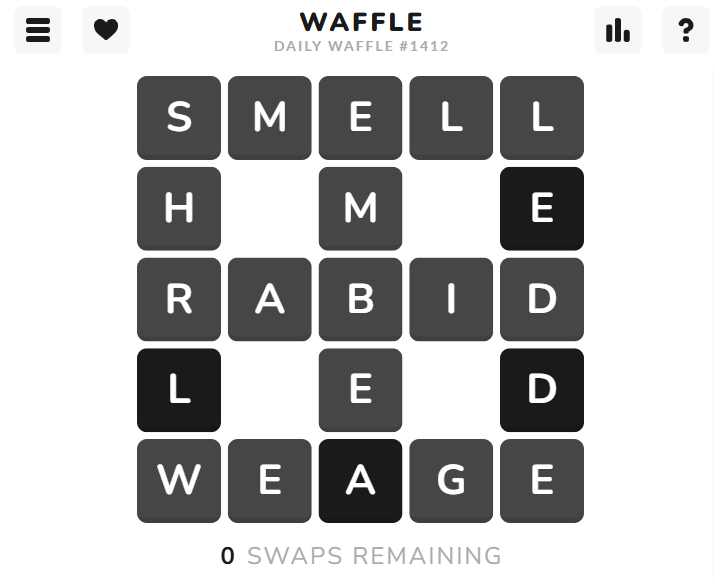
I spend the first 20-30 seconds just looking at greens. Not swapping anything, just observing. Where are they positioned? What word patterns do they suggest? If I see “_ _ E _ _” with a green E in the middle, I’m immediately thinking BREAK, GREAT, SPEED, or similar words.
The key insight: green letters at intersections tell you about TWO words simultaneously. A green ‘R’ where a horizontal and vertical word cross means both words need an ‘R’ in that exact spot. This limits your options dramatically.
Technique 2: Start With the Most Green Word
Always solve the word with the most green letters first.
If one word has three greens and another has one green, tackle the three-green word immediately. Why? Because you’re 60% of the way to solving it already. And when you complete that word, the letters you’ve placed will inform the intersecting words.
I made the mistake early on of trying to solve all words equally. Wasted probably 30-40 extra swaps over my first 20 puzzles doing this. Focus your efforts where you have the most information.
Technique 3: Yellow Letter Logic
Yellow letters belong in that word, just not in that position. This is huge for beginners.
When I see a yellow ‘T’ in position 1 of a five-letter word, I know it needs to move to position 2, 3, 4, or 5. But here’s what beginners miss: look at the other letters in that word. If position 5 already has a green ‘D’, the ‘T’ probably isn’t going there (most words don’t end in TD). Use context clues.
A pattern I noticed around puzzle 40: yellow letters often need to move just one or two positions. If you see yellow in position 2, try position 3 or 4 before testing position 1 or 5. This saves swaps through probability.
Technique 4: Common Word Endings First
English loves certain endings: -ER, -ED, -LY, -ST, -NG.
When I see letters like E, R, D scattered around, I immediately check if they can form these common endings. Same with I, N, G. If those three letters appear in a word with yellows and whites, testing them as -ING often reveals the correct word instantly.
This shortcut alone probably saved me 50+ swaps over my first two months. Word endings are predictable—use that predictability.
Looking for more? Explore the Dordle game guide here.
Intermediate Techniques: Thinking Strategically
Once you’re comfortable with basics, these techniques will push you toward consistent single-digit swaps.
Technique 5: The Intersection Cascade
This changed everything for me around puzzle 60.
Every swap at an intersection point affects multiple words. If I swap two letters at an intersection, I’m simultaneously working on a horizontal word AND a vertical word. Smart players exploit this.
Here’s how: identify intersections with the most yellow/white letters. Swapping at these high-uncertainty intersections gives you more information per move. If you swap at an intersection and suddenly three letters turn from white to yellow, you’ve just learned that those letters belong in their respective words—even if they’re not in the right positions yet.
Technique 6: Process of Elimination Swapping
When you’re stuck between two letter placements, test one immediately.
Let’s say you need to place an ‘A’ and you’ve narrowed it down to two positions in a word. Don’t overthink it—swap it to position A. If it stays white or turns yellow, you know it doesn’t go there. Immediately swap it to position B. This uses two swaps but eliminates uncertainty completely.
I used to waste 3-4 swaps trying to logic my way through these situations. Now I just test. It’s faster and more reliable.
Technique 7: Vowel Distribution Strategy
Most five-letter words have 2-3 vowels. Use this.
When I’ve placed four letters in a word and four of them are consonants, the fifth spot almost certainly needs a vowel. This sounds obvious but I constantly see beginners trying consonant combinations that don’t exist in English.
Conversely, if I’ve placed three vowels already, the remaining spots probably need consonants. This simple rule eliminates probably 40% of possible letter placements, making your decision-making much faster.
Technique 8: The Rare Letter Priority
Q, X, Z, J—these letters have limited placement options.
I learned around puzzle 75 to always place rare letters first. A Q almost always pairs with U. An X usually appears at the end of words or in position 2-3. Z loves word endings. J typically starts words or appears in position 2.
When I see a rare letter, I solve for it before anything else. This anchors your solution because rare letters have so few valid positions. Everything else falls into place easier once they’re locked in.
Advanced Techniques: Maximizing Efficiency
These techniques consistently get me to 8-9 swaps. They require pattern recognition you’ll develop with practice.
Technique 9: Predictive Swapping
Instead of reacting to what colors appear, predict what SHOULD happen before you swap.
Before each swap, I mentally visualize: “If I move this ‘R’ here, it should turn green, and that ‘E’ in the vertical word should turn yellow.” Then I execute. If my prediction is wrong, I’ve learned something important about the word structure.
This proactive thinking versus reactive swapping is probably the biggest difference between 11-swap solvers and 8-swap solvers. You’re not just moving letters—you’re testing hypotheses.
Technique 10: The Double-Solve Method
This is my favorite advanced technique.
Instead of completing words sequentially, I work on two intersecting words simultaneously. I’ll make a swap that partially completes the horizontal word while simultaneously partially completing the vertical word passing through it.
Example: If swapping an ‘O’ to complete STORM horizontally also places that ‘O’ correctly for FLOAT vertically, I’ve made progress on both words with one swap. Look for these double-win opportunities constantly.
Technique 11: Swap Counting Strategy
After about 5 swaps, I start counting remaining moves differently.
If I’ve used 5 swaps and have three words remaining, I know I have 10 swaps left—roughly 3-4 swaps per word. This mental accounting prevents me from spending 6 swaps on one stubborn word while neglecting the others.
The moment I hit 8 swaps used, I reassess everything. Am I on track to finish in 10 or fewer? If not, I backtrack and verify my high-confidence words because I’ve probably made a mistake.
Technique 12: Pattern Library Building
After 130+ puzzles, I’ve unconsciously built a library of common Waffle words.
Words like CRANE, STARE, PROUD, SWIFT, BLEND, STONE, BEACH, FRAME appear repeatedly. When I see their letters scattered, I test these words first. This isn’t memorization—it’s pattern recognition from repetition.
You’ll develop your own library naturally. I started keeping a notes file around puzzle 90 of words I’d seen multiple times. Sounds nerdy, but it shaved a full swap off my average.
Troubleshooting Common Mistakes
Even with solid techniques, everyone hits walls. Here’s how I work through them.
Problem: Stuck at 12-13 swaps with one unsolved word
This usually means you’ve misidentified a “completed” word. I backtrack to the word I solved earliest and verify it. Sometimes what I thought was PRINT is actually POINT, and accepting that means rearranging 3-4 letters. Always question your assumptions before your last few swaps.
Problem: Multiple white letters with no clear home
Stop and list out all six words you think you have. Say them out loud. Often you’ve created a word that doesn’t exist or used a letter twice. When I verbalize my solutions, mistakes become obvious.
Problem: Two words seem equally valid
The tiebreaker is always intersecting words. Test option A—do the intersecting words remain valid? Test option B—same check. Whichever option creates more greens/yellows in other words is probably correct.
Practice Path That Actually Works
If you want to improve quickly, here’s what worked for me.
Play the daily puzzle every morning for a week without any special focus. Just play. Track your swaps: write down how many you used each day.
Week two: Focus exclusively on the Green Letter Anchor Method. Before making any swaps, study the greens for 30 seconds. Your swap count should drop by 1-2 just from this.
Week three: Add the intersection cascade technique. Consciously make swaps at intersections and watch how information spreads to multiple words.
Week four: Start predicting outcomes before swapping. This mental practice accelerates pattern recognition faster than anything else I tried.
By week five, you’ll be averaging at least 3 fewer swaps than week one. I went from 14 average to 11 average in this timeframe, which felt huge.
The Honest Reality
You won’t become an expert overnight. I still occasionally use 12-13 swaps on particularly tricky puzzles.
But here’s what changed for me: puzzles that once took 15 swaps now take 9. Puzzles I couldn’t solve at all are now routine. The satisfaction of seeing your average drop over time is surprisingly motivating.
Start with the beginner techniques. Master those before moving to intermediate. The advanced stuff will come naturally once you’ve played 50-60 puzzles because you’ll start seeing patterns automatically.
Most importantly: be patient with yourself. Every failed swap teaches you something about word structure, letter patterns, or your own solving tendencies. I learned more from my 14-swap failures than my 8-swap successes.
Give these techniques a shot on tomorrow’s puzzle. Focus on one or two, not all twelve at once. You’ll see improvement within three days, guaranteed.

Rajat Singhaal is the founder and lead writer of this website, with over one year of experience in the gaming industry. He focuses on researching and creating high-quality content related to online games, with a particular expertise in word puzzle and logic-based games. In his free time, Rajat actively plays and analyzes puzzle games to stay updated with gameplay trends and strategies. He holds a Bachelor of Commerce (B.Com) degree.