
Dordle Game Guide 2026: How to Solve Two Wordles Simultaneously
The first time I opened Dordle, I stared at two Wordle boards side by side and thought, “This looks manageable.”
I used all seven guesses but didn’t solve either board on my first attempt.
Turns out, solving two Wordles at once requires a completely different approach than solving a regular Wordle. After 120+ Dordle games, I’ve learned that success isn’t about being twice as good at Wordle—it’s about strategic thinking and information maximization.
Here’s everything you need to know about Dordle, from the basic mechanics to why it’s harder than you’d expect.
Looking for the Waffle Game Answer Today.

What is Dordle?
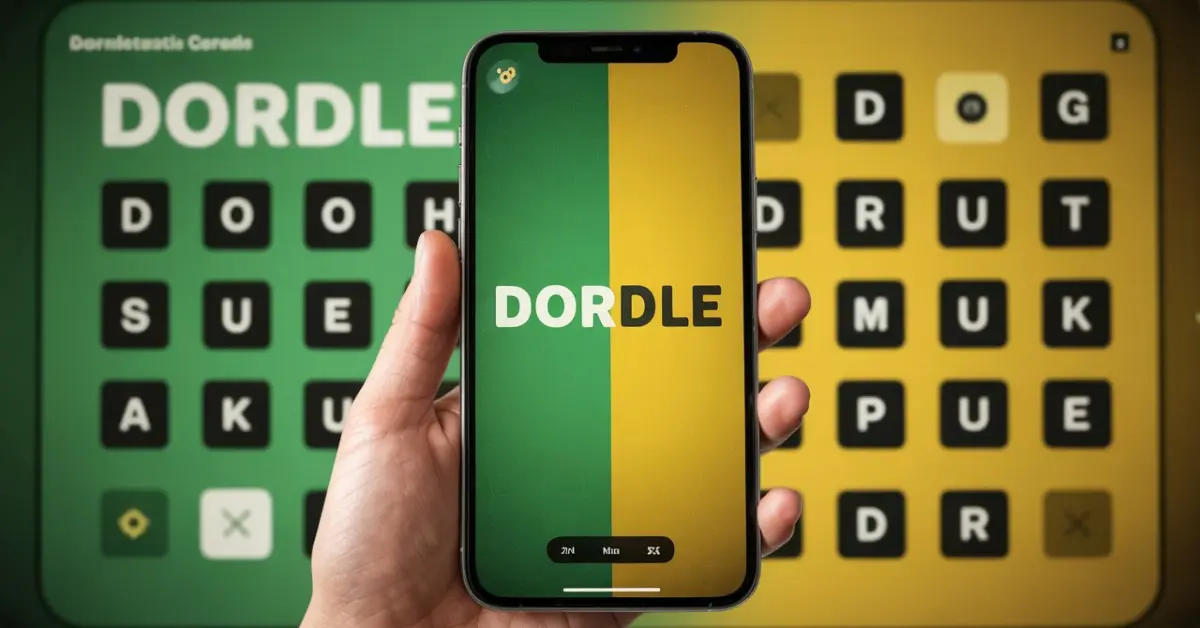
Dordle is exactly what it sounds like: double Wordle. You solve two five-letter words simultaneously using the same guesses for both boards.
When you type a guess, it appears on both the left board and the right board. Each board gives you independent color feedback—green for correct position, yellow for wrong position, gray for not in the word. You get seven total guesses to solve both words.
The main challenge is managing information across two puzzles. A guess that works perfectly for the left board might be useless for the right board, and vice versa. You must constantly decide which board needs more attention.
Created as part of the Wordle-variant explosion in early 2022, Dordle has stayed popular because it hits a sweet spot: challenging enough to be interesting, but not so difficult that it’s frustrating. Unlike some variants that add gimmicks, Dordle just doubles the core Wordle experience.
If Also Play Canuckle Here is Today’s Canuckle Answer See.

How Your Guesses Affect Both Boards
This is the mechanic that confuses new players.
Every guess you type appears on BOTH boards simultaneously. If you guess CRANE, both the left and right boards evaluate CRANE against their respective answers and give you color feedback.
Here’s where it gets interesting: the feedback is completely independent. CRANE might be terrible for the left board (all grays), but reveal three yellows on the right board. You’re getting two sets of information from one guess.
What I learned by game 30: you’re not solving two separate Wordles—you’re solving one optimization problem. Each guess should ideally advance both puzzles, not just one. When I started treating Dordle as a balancing act instead of “Wordle twice,” my success rate jumped from 55% to 78%.
The strategic tension is constant. Do you use Guess 4 to confirm the left board’s word even though the right board still has multiple possibilities? Or do you gather more information for the right board and risk running out of guesses?
Key Differences From Regular Wordle
This is the mechanic that confuses new players.
Every guess you type appears on BOTH boards simultaneously. If you guess CRANE, both the left and right boards evaluate CRANE against their respective answers and give you color feedback.
Here’s where it gets interesting: the feedback is completely independent. CRANE might be terrible for the left board (all grays), but reveal three yellows on the right board. You’re getting two sets of information from one guess.
What I learned by game 30: you’re not solving two separate Wordles—you’re solving one optimization problem. Each guess should ideally advance both puzzles, not just one. When I started treating Dordle as a balancing act instead of “Wordle twice,” my success rate jumped from 55% to 78%.
The strategic tension is constant. Do you use Guess 4 to confirm the left board’s word even though the right board still has multiple possibilities? Or do you gather more information for the right board and risk running out of guesses?
The Seven-Guess Strategy
Seven guesses sounds like plenty. It’s not.
Here’s how I typically allocate guesses:
Guesses 1-2: Pure information gathering. I use two different high-coverage words (like CRANE and STUMP) to test 10 different letters across both boards. At this point, I’m not trying to solve anything—just collecting data.
Guess 3: First targeted attempt. By now, one board usually has more information than the other. Guess 3 targets, whichever board is closer to the solution, while still providing useful letters for the other board.
Guesses 4-5: Split focus. If I solved one board on guess 3, guesses 4-5 work on the remaining board. If both boards are still unsolved, I alternate focus—guess 4 for the left board, guess 5 for the right board.
Guesses 6-7: Finish or fail. These are my safety guesses. If I haven’t solved both boards by guess 5, I’m usually in trouble. Guesses 6-7 are desperate attempts to salvage at least one board.
The math is unforgiving: you need to average 3.5 guesses per board. In regular Wordle, my average is 3.8 guesses. The time pressure of splitting seven guesses across two boards makes everything tighter.
Daily Dordle vs Free Play
Dordle offers two main modes, and the experience differs significantly.
Daily Dordle resets once per day at midnight. Everyone worldwide gets the same two words. Your results are shareable as emoji grids (just like Wordle), and there’s a competitive element since you can compare with friends.
I play Daily Dordle every morning after regular Wordle. It’s become part of my routine: coffee, Wordle, Dordle, start the day. Takes about 5-7 minutes total.
Free Play (Unlimited Mode) lets you play infinite random Dordles. This is perfect for practice or when you want more than one daily puzzle. The words are randomly generated, not curated, which means you occasionally get obscure answers that wouldn’t appear in Daily mode.
I used Free Play heavily in my first month to learn strategies without waiting 24 hours between attempts. Played probably 60-70 Free Play games before I felt comfortable with my approach.
Sequence Mode (which I discovered around game 80) is a third option where you solve a series of Dordles back-to-back. It’s like a Dordle marathon. I rarely play this because it’s exhausting—solving 10 Dordles in a row is mentally draining.
How Difficult Is Dordle Actually?
Harder than Wordle, easier than you’d expect after failing your first attempt.
My Wordle win rate: 97%. My Dordle win rate: 81%. That 16-point gap represents the increased difficulty of juggling two boards.
But here’s the thing: Dordle is consistently solvable if you approach it strategically. Unlike Wordle, where you can get screwed by an unlucky word (FOYER, anyone?), Dordle’s difficulty is more about your strategy than luck.
The hardest part isn’t the vocabulary or letter patterns—it’s the mental load. Tracking two boards simultaneously while planning guesses that advance both puzzles requires focus. On days when I’m distracted or tired, my Dordle performance drops noticeably.
For Wordle players: If you solve Wordle regularly, expect Dordle to take about 2 weeks to “click.” Your first 10-15 attempts will probably have a ~50% success rate. By attempt 30, you’ll be above 70%. By attempt 60, you’ll be above 80%.
For beginners: If you’re new to word games entirely, start with regular Wordle first. Dordle assumes you understand the basic mechanics and color-coding system. Jumping straight into Dordle is like learning to juggle by starting with three balls instead of two.
The difficulty sweet spot is what keeps me playing. It’s hard enough to feel accomplished when I succeed, but not so hard that I rage-quit. Most puzzles are solvable in 5-6 guesses if I stay focused.
Common First-Time Mistakes
I made all of these in my first week.
Mistake #1: Trying to solve one board completely before touching the other. This burns too many guesses. By the time you finish board one, you’ve got 2-3 guesses left for board two, which isn’t enough.
Mistake #2: Using guesses that only help one board. Every guess should ideally advance both puzzles. If a guess gives you information for only one board, you’re wasting efficiency.
Mistake #3: Not tracking letter elimination. With two boards, it’s easy to lose track of which letters are eliminated where. I now mentally (or physically on paper) track grays separately for each board.
Mistake #4: Panicking when both boards are unsolved by guess 5. This is actually normal. Most of my successful solves happen on guesses 5-7. Stay calm and make strategic guesses.
Mistake #5: Forgetting it’s okay to fail one board. Some days, you’ll realize by guess 5 that solving both boards is impossible. At that point, prioritize solving one board successfully over failing both. Partial success beats total failure.
Why People Love Dordle
After 120+ games, I still open it daily. Here’s why it works.
The difficulty is perfect for Wordle veterans. If you’ve been playing Wordle for months and it’s become too easy, Dordle offers the perfect step up. It’s not gimmicky or frustrating—just harder in a logical way.
The time investment is reasonable. Daily Dordle takes me 5-8 minutes. It’s challenging without being a time sink. I can do it during my morning coffee without it eating into my schedule.
Success feels earned. Solving both boards with 1-2 guesses to spare feels legitimately satisfying. Unlike Wordle, where luck plays a big role, Dordle success feels more skill-based.
The failure rate is acceptable. I fail about 19% of my Dordle attempts, which is frustrating but not demoralizing. The difficulty is calibrated well—you fail often enough to stay humble but succeed often enough to keep playing.
It’s still just Wordle at its core. Some variants add complex rules or gimmicks that change the game fundamentally. Dordle keeps it simple: it’s just two Wordles at once. That simplicity is elegant.
Getting Started
If you’re ready to try Dordle, here’s my advice after 120+ games.
Start with the Daily Dordle at zaratustra.itch.io/dordle. One puzzle per day lets you build skills gradually without overwhelming yourself.
Use your first 10 attempts as learning experiences. You’ll probably fail 5-7 of them. That’s normal and expected. Pay attention to why you failed: ran out of guesses? Focused too much on one board? Couldn’t narrow down the final letter?
After 10 daily puzzles, if you want more practice, use Free Play mode to experiment with different strategies. I found my optimal approach by testing various starting word combinations in Free Play.
Don’t expect to maintain your Wordle success rate. If you win 90%+ of Wordle games, expect your Dordle rate to start around 50% and climb to maybe 75-80% with practice. That’s normal and doesn’t mean you’re bad at it—Dordle is genuinely harder.
Most importantly, treat it as one optimization problem, not two separate Wordles. That mental shift is what separates people who enjoy Dordle from people who find it frustrating.
The jump from regular Wordle to Dordle is real, but it’s manageable. Give it 20 attempts before deciding if it’s for you. For me, it became a permanent part of my daily word game routine.

Aman Singhaal is the lead writer of this website, with over one year of experience in the gaming industry. He focuses on researching and creating high-quality content related to online games, with particular expertise in word puzzles and logic-based games. In his free time, Rajat actively plays and analyses puzzle games to stay updated with gameplay trends and strategies. He holds a Bachelor of Commerce (B.Com) degree.


